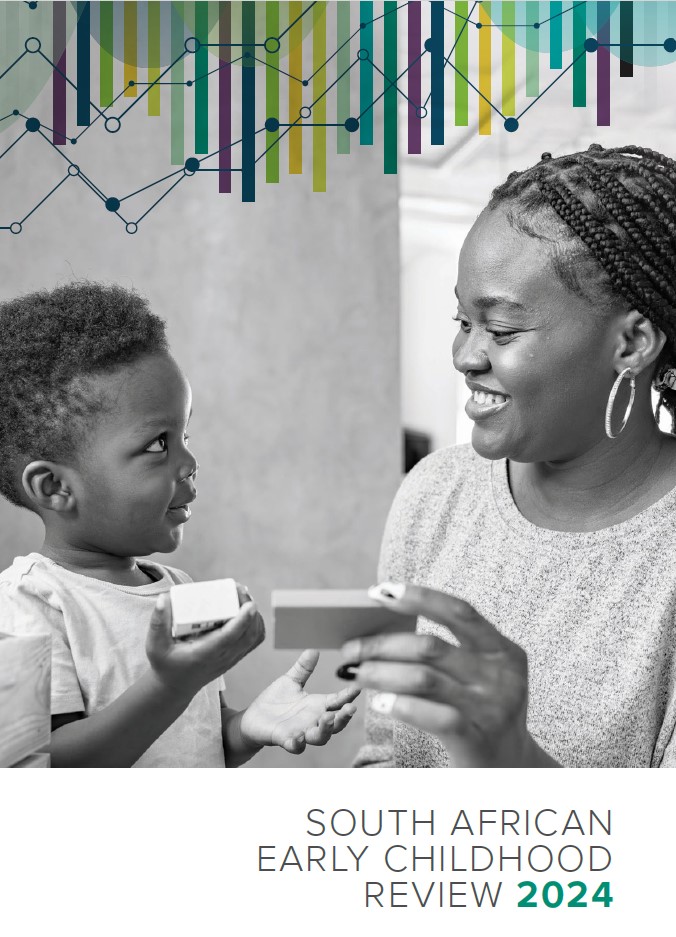
 The SAECR 2024 tracks trends on the status of children under 6.


 Education
This indicator shows the number and percentage of children aged 7 – 17 years who are reported to be attending a school or educational facility. This is different from “enrolment rate”, which reflects the number of children enrolled in educational institutions, as reported by schools to the national Department of Basic Education early in the school year.
Analysis by Katharine Hall & Sumaiyah Hendricks, Children's Institute, University of Cape Town.
- Children are defined as persons aged 0 – 17 years.
- Population numbers have been rounded off to the nearest thousand.
- Sample surveys are always subject to error, and the proportions simply reflect the mid-point of a possible range. The confidence intervals (CIs) indicate the reliability of the estimate at the 95% level. This means that, if independent samples were repeatedly taken from the same population, we would expect the proportion to lie between upper and lower bounds of the CI 95% of the time. The wider the CI, the more uncertain the proportion. Where CIs overlap for different sub-populations or time periods we cannot be sure that there is a real difference in the proportion, even if the mid-points differ. CIs are represented in the bar graphs by vertical lines at the top of each bar.
- Denominator is based on children of school-going age: 7-17 years.
Section 29 (1)(a) of the South African Constitution states that “everyone has the right to a basic education”, and section 29 (1)(b) says that “everyone has the right to further education” and that the state must make such education “progressively available and accessible”.[1]
Article 11 (3)(a) of the African Charter on the Rights and Welfare of the Child says “States Parties to the present Charter shall take all appropriate measures with a view to achieving the full realization of this right and shall in particular … provide free and compulsory basic education”.[2]
Article 28 of the United Nations Convention on the Rights of the Child recognises “the right of the child to education” and also obliges the state to “make primary education compulsory and available free to all”.[3]
Education is a transformative socio-economic right that provides the foundation for lifelong learning and economic opportunity. All children have a right to basic education, which the Constitutional Court has ruled extends to Grade 12.[4]
Historically, basic education has been compulsory from Grade 1 (the year in which a child turns seven). The Basic Education Laws Amendment (BELA) Act was signed by the President on 13 September 2024 and came into effect on 24 December 2024.[5,6] The BELA Act means that from 2025, Grade R has been formally integrated into the foundation phase and has become compulsory for children in the year that they turn six. Because this indicator gives a retrospective view of attendance rates, it still measures attendance against the previous compulsory starting age for children. The compulsory stage ends on completion of Grade 9 or when the child turns 15. After this, children may leave school, but the state has a responsibility to provide basic education up to the end of Grade 12 for those who want to complete school.
South Africa has high levels of school enrolment and attendance. Among children of school-going age (7 – 17 years), the vast majority are reported to attend some form of educational facility. There was a small but significant increase from 2002 when the reported attendance rate was 95%, to 2018 when reported attendance rates were 98%. The overall increase was mainly due to the growth in reported attendance rates for African and Coloured children, and in 2018 for the first time since this indicator was tracked, there were no significant differences in attendance rates across race groups.
All schools were closed between March and June 2020, due to the outbreak of COVID-19 and the resultant lockdown. From June, schools partially re-opened, but only for specific grades. Schools re-opened for all grades from late August 2020, but even then, they operated at reduced capacity with rotational timetabling of classes.
Statistics South Africa (Stats SA) ran its 2020 General Household Survey (GHS) later than usual, from September to December. The survey included the usual question about whether household members were attending an educational institution but did not ask whether they were attending every day. Thus, reported attendance rates do not reflect the regularity of attendance, even at a time when it is known that learners were unlikely to be attending every day. Reported attendance rates in the last quarter of 2020 were at a similarly high level as previous years, with just a small decrease of one percentage point from 2019, to 97%. Wave three of the National Income Dynamics Study – Coronavirus Rapid Mobile Survey (NIDS-CRAM) survey, conducted in November 2020, asked whether children had attended school at any time in the last seven days. The overall estimate was 98%, a similar attendance rate to that reported in the GHS. Attendance rates earlier in the year had been much lower, and varied substantially by grade, ranging from 88% for Grade 12 learners to as low as 11% for Grade 9 learners.[7] This was due to the staggered re-opening of grades and prioritisation of those approaching the end of the primary or secondary school.
Reported attendance rates remained at 97 – 98% in 2021 – 2024. Of the 12.9 million children aged 7 – 17 years in 2024, 12.6 million were reported to attend school (97%), while 330,000 were not attending. Attendance rates were similarly high across all provinces.
Overall attendance rates tend to mask dropout among older children. Analysis of attendance among discrete age groups shows that although there is a slight drop in reported attendance among children beyond the compulsory schooling phase, attendance still remains at 95% for children aged 16, dropping to 93% among 17-year-olds. At age 18 there is a substantial drop: to around 85% among young people who have not completed Grade 12. Differences in reported school attendance rates between boys and girls are not statistically significant.
The GHS asks about reasons for non-attendance for those who are not attending an educational institution. The main reasons for non-attendance can be divided into three main categories: system failures (including exclusions and quality problems); financial barriers; and illness or disability. Together, these account for nearly two thirds of non-attendance.
Of the school-age children who were not attending any school in 2024, 11% were “unable to perform at school”, 5% left because “education is useless or not interesting” while a nominal 1% dropped out because they failed their exams. Worryingly, 10% of those not attending were not accepted for enrolment, up from 4% in 2022 and suggesting that capacity constraints may be an emerging obstacle to the realisation of this important right. Together, these reasons signal failures in the education system and account for nearly 30% of all reported non-attendance.
The second main barrier to education is financial or accessibility constraints. These include the cost of schooling (the reason given for 14% of children not attending schools in 2024) and difficulties in reaching school (2% were not attending because the school is too far). Six percent of those not attending were too busy due to work or domestic responsibilities, suggesting that for some families the opportunity cost of education is a barrier.
Disability is also an important reason, accounting for 8% of non-attendance in 2024 and again pointing to a failure in the education system to accommodate children with disabilities. Illness accounted for an additional 4% of the non-attendance rate.
Pregnancy accounts for 3.5% of all non-attendance, and 8.5% of non-attendance among teenage girls who are not attending school.[8-10]
Although the costs of education are cited as a barrier to attendance, the overall attendance rate for children in the lower income quintiles is not substantially lower than those in the wealthier quintiles, although there is a statistically significant difference in reported attendance rates for children in the poorest income quintile (97%) compared with the richest income quintile (99%).
Attendance rates alone do not capture the regularity of children’s school attendance or their progress through school. Research has shown that children from more disadvantaged backgrounds – with limited economic resources, lower levels of parental education, or who have lost their mother – are more prone to dropping out or progressing more slowly than their more advantaged peers. Racial inequalities in school advancement remain strong.[11,12] Similarly, school attendance rates tell us nothing about the quality of teaching and learning.[13] Inequalities in learning outcomes are explored through standardised tests such as those used in the international SAQMEC,[14] TIMMS and PIRLS[15] studies. The DBE’s controversial Annual National Assessments[16] were discontinued in 2017, meaning that the only national standardised assessment is matric.
‘Attendance’ thus reflects the proportion of children that were reported as “attending school” by one of the adults in their household interviewed for the GHS, which is conducted in July each year. This is different from “enrolment rates” that reflect the number of children enrolled in a basic or secondary educational institution, as reported by the schools to the national government early in the school year. Annual enrolment rates can be found in the Department of Education’s Education Statistics in South Africa, published each year.
The number of children aged 7 – 17 years (school-going age) who were attending an educational institution was extracted from the GHS data. This figure was divided by the number of children of school-going age to develop the proportion of children of school-going age attending an educational facility. The numbers of children in each province aged 7 – 17 years were also determined, and the same procedure was applied to develop the provincial attendance rates.
The GHS uses a Master Sample frame which has been developed as a general-purpose household survey frame that can be used by all other Stats SA household-based surveys that have design requirements that are reasonably compatible with the GHS. The sample is drawn from Census enumeration areas using a stratified two-stage design with probability proportional to size sampling of PSUs in teh first stage, and sampling of dwelling units with systematic sampling in the second stage. The resulting sample consists of just over 20,000 households with around 70,000 individuals, and should be representative of all households in South Africa. It is also designed to be representative at provincial level and within provinces at metro/non-metro levels and three geography types (urban areas, rural areas under traditional authority, and farms).
The sample consists of households and does not cover other collective institutionalised living-quarters such as boarding schools, orphanages, students’ hostels, old-age homes, hospitals, prisons, military barracks and workers’ hostels. These exclusions probably do not have a noticeable impact on the findings in respect of children.
Changes in sample frame and stratification
Since 2014 the GHS has been based on the 2013 master sample that that is, in turn, based on information collected during the 2011 Population Census. The previous master sample for the GHS was used for the first time in 2008, and the one before that in 2004. These again differed from the master sample used in the first two years of the GHS: 2002 and 2003. Thus there have been four different sampling frames during history of the annual GHS, with the changes occurring in 2004, 2008 and 2013. In addition, there have been changes in the method of stratification over the years. These changes could compromise comparability across iterations of the survey to some extent, although it is common practice to use the GHS for longitudinal monitoring and many of the official trend analyses are drawn from this survey.
Weights
Person and household weights are provided by Stats SA and are applied in Children Count analyses to give population estimates on the indicators. The GHS weights are derived from Stats SA’s mid-year population estimates for the relevant year. The population estimates are based on a model that is revised from time to time when it is possible to calibrate the population model to Census data and larger population surveys such as the Community Survey.
In 2017, Stats SA revised its demographic model to produce a new series of mid-year population estimates and the GHS data were re-released with the revised population weights. All the Children Count indicators were re-analysed retrospectively, using the revised weights provided by Stats SA, based on the 2013 model. The estimates are therefore comparable over all years. The revised weights particularly affected estimates for the years 2002 – 2007.
The 2017 model drew on the 2011 census, along with vital registration, antenatal and other administrative data, but was a “smoothed” model that did not mimic the unusual shape of the age distribution found in the census. The results of the 2011 census were initially distrusted because it seemed to over-count children in the 0 – 4 age group and under-count children in the 4 – 14-year group. It is now thought that the fertility rates recorded in the 2011 population census may have been an accurate reflection of demopraphic trends, with an unexplained upswing in fertility around 2009 after which fertility rates declined again gradually. Similar patterns were found in the vital registration data as more births were reported retrospectively to the Department of Home Affairs, and in administrative data from schools, compiled by the Department of Basic Education. In effect, this means that there may be more children in South Africa than appear from the analyses presented in these analyses, where we have applied weights based on a model that it is now known to be inaccurate.
Stats SA has subsequently developed a new population model - the 2022 series, which provides revised mid-year population estimates back to 2002 and projected to 2032. However, the GHS series has not yet been reweighted.The population estimates in Children Count are therefore based on weights derived from outdated population model (2017). It is not yet clear when and how the population model will be revised again following the 2022 Census, as there are concerns around census under-count and plausibility of its findings.
Disaggregation
Statistics South Africa suggests caution when attempting to interpret data generated at low level disaggregation. The population estimates are benchmarked at the national level in terms of age, sex and population group while at provincial level, benchmarking is by population group only. This could mean that estimates derived from any further disaggregation of the provincial data below the population group may not be robust enough.
Reporting error
Error may be present due to the methodology used, i.e. the questionnaire is administered to only one respondent in the household who is expected to provide information about all other members of the household. Not all respondents will have accurate information about all children in the household. In instances where the respondent did not or could not provide an answer, this was recorded as “unspecified” (no response) or “don’t know” (the respondent stated that they didn’t know the answer).
For more information on the methods of the General Household Survey, see the metadata for the respective survey years, available on Nesstar or DataFirst
Supported by


Previous Funders


46 Sawkins Road
Rondebosch, 7700
South Africa
Tel: +27 (0)21 650 1473
Email: info.ci@uct.ac.za